Replaced the eBay publisher behind 36,000 live listings in 15 days, before the old one switched off
A specialist retailer of original cinema posters and physical media, with 36,000 live eBay listings routed through a third-party publisher that announced it was closing. I built Overlook, the inventory and listing system that took over publishing and order routing, and landed the switch two days before the deadline.
At a glance
- Client
- Rendezvous Cinema, Chichester, original cinema posters, lobby cards and physical media
- Role
- Fractional ecommerce and technology consultant, 2024 to present
- Catalogue
- 36,450 SKUs on Shopify, about 36,000 of them live on eBay UK, plus AbeBooks
- Built
- Overlook, the inventory and listing system that replaced Inkfrog
- Cutover
- 15 days from plan to live, 29 May 2026, two days before Inkfrog shut down
- Orders
- About 185 a month riding on the switch
- Website
- rendezvouscinema.com
The situation
Rendezvous Cinema holds a large and unusual inventory: original cinema posters, lobby cards and physical media, much of it one of a kind. Shopify is the store and the source of truth, and for years a third-party tool, Inkfrog, published the catalogue to eBay and routed eBay orders back into Shopify. In spring 2026 Inkfrog announced it was closing at the end of May. Around 36,000 live listings, a decade of eBay listing history and account health, and roughly 185 orders a month depended on it. Losing the listings would have meant starting eBay from nothing.
What I did
Audited what the old tool actually did. Exported every one of Inkfrog’s 45,568 rows and compared them with a snapshot of the Shopify catalogue. That established the migration path: 36,443 of 36,450 SKUs matched cleanly, only 35 stocked items existed in Inkfrog alone, and the item specifics column was an empty wrapper on every listing. Every listing was going to need its specifics built from scratch.
Set the rules before the build. Never delete or bulk-modify Shopify product data, tags or collections, because the AbeBooks campaigns and Google Shopping feeds depended on them. Never end or bulk-modify a live eBay listing, because ranking and account health depended on their continuity. Every bulk operation got a dry run, a preview and a small canary before it touched anything at volume.
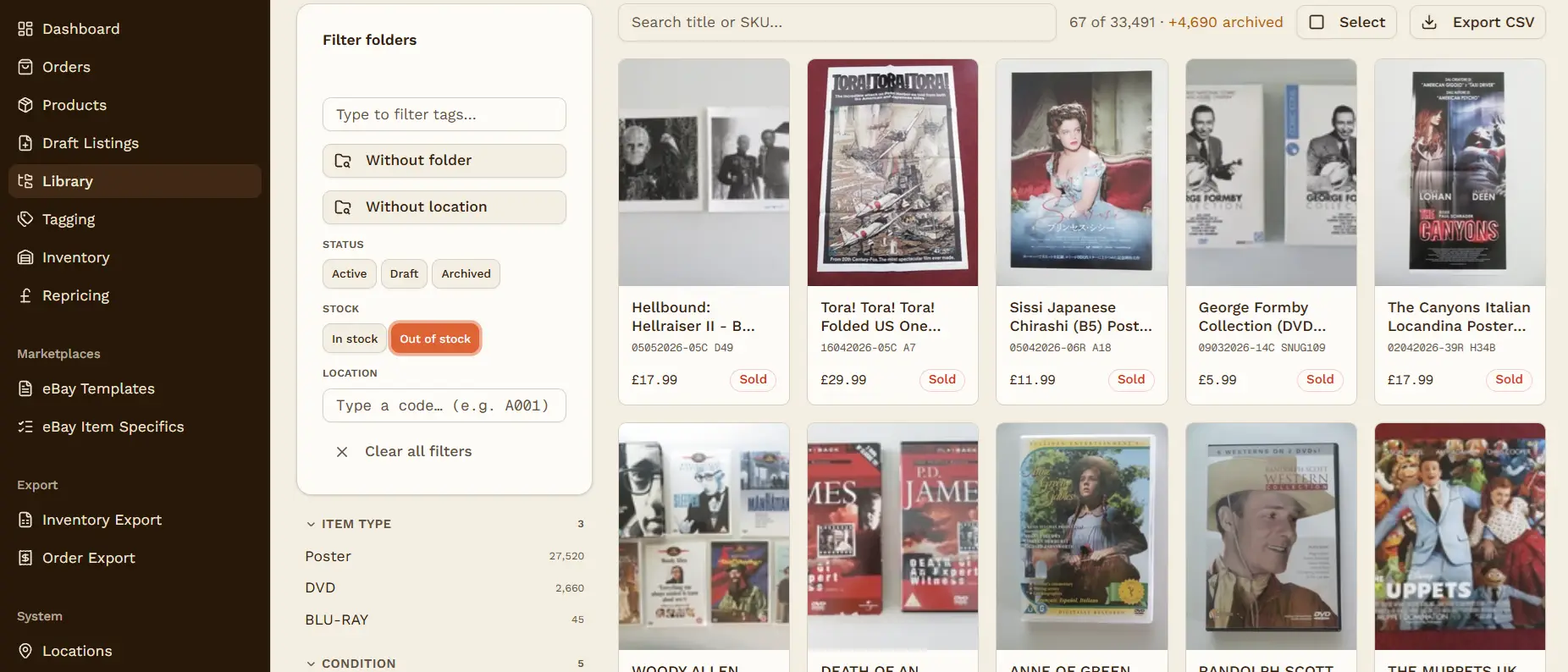
Built Overlook and cut over in 15 days. Planned on 14 May, live on 29 May. The system connects to eBay through OAuth, maps every live listing to its Shopify SKU with read-only calls, polls eBay for new orders every two minutes and creates them in Shopify, and ends the eBay listing the moment an item sells on the website, one SKU at a time. New listings publish with condition grades, shipping profiles, the store’s own description template and item specifics filled from the Shopify data. Login, an audit trail of every change and the safety switches shipped in the same window.
Kept building after the deadline. Two-way sync with Shopify, orders and packing slips, draft listings with delayed publishing, physical stock locations, film metadata prefilled from OMDb and TMDb, images moved onto storage the business controls, CSV export, and 493 mis-categorised products put right. A backlog of feedback from the people using it every day was worked through item by item.
Opened new channels alongside it. Set up and launched the Amazon marketplace account alongside the existing Amazon Pay integration, so the same stock could be listed in more than one place.
What made the difference
Two rules set before any code was written. The new system had to be additive during cutover, reading the old one rather than overwriting it, and no bulk change went live without a dry run and a small canary first. That is what made it safe to move 36,000 listings in a fortnight without touching a single one that was already selling.